
02 Mar Growing money on trees: The Strategic Role of Timberland in a strategic Asset Allocation by Christoph Junge
In a time when markets are defined by volatility, inflation concerns, and the growing demand for sustainable investing, one asset class is quietly delivering solid returns with low correlation to traditional markets: timberland.
For long-term investors seeking diversification, capital preservation, and a tangible hedge against inflation, investing in timberland, which is the investment in commercially managed forests, can offer a compelling addition to a multi-asset portfolio, making it even more balanced and resilient. And this holds true regardless of whether you are managing a multi-billion institutional portfolio or a family trust.
Even though timberland investing is not as mainstream as for example real estate yet, there are signs of increased interest. According to the 2024 Nuveen Equilibrium Institutional Investor Survey almost half (44%) of global institutional investors invest or plan to invest in timberland.
MEAG, the asset manager of Munich Re, a major German insurance company, is one of the institutional investors driving timberland investments. It recently led a consortium in acquiring 175,000 hectares of forest land in Sweden for €900 million from Stora Enso.
A Natural Diversifier
Timberland possesses a number of portfolio characteristics that make it highly attractive. It has low correlation with traditional asset classes like equities and bonds, and historically, it has shown remarkable resilience during periods of market turbulence. One of its defining features is that trees continue to grow regardless of economic growth – one could say mother nature doesn’t care about recessions. This biological growth is predictable, tangible, and steadily compounding. Investors are, quite literally, watching their assets grow. Another nice feature of timberland investments is a free timing option embedded. Foresters talk about “storing on the stump”, meaning that you do not have to harvest the trees if log prices are not attractive enough. You can literally store the wood on the stump, which is not possible in for example farmland investments, where you have to harvest the crops once they are ripe.
Moreover, timberland provides an effective hedge against inflation. Wood products tend to rise in price alongside general inflation, and timberland returns have historically tracked inflation closely.
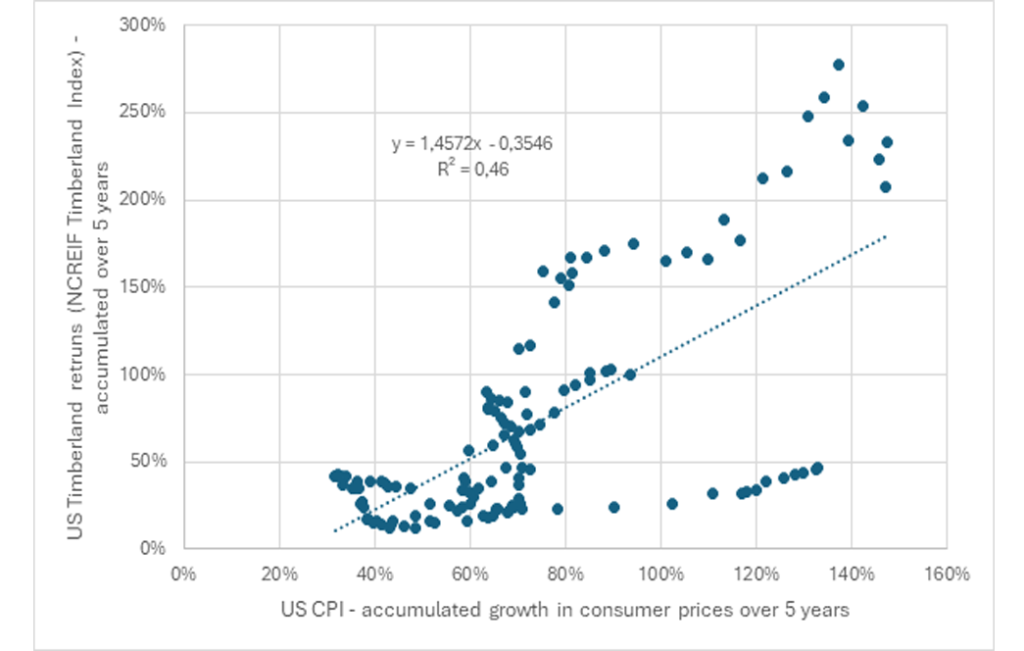
As shown in figure 1, the rolling 5-year returns of timberland and rolling 5-year growth rates in consumer prices are positively correlated. The r-squared of 0,46 equals a correlation coefficient of 0,68, meaning that timberland shows a moderate to strong positive correlation with inflation, which suggests it can serve as an effective inflation hedge. Trees keep growing regardless of economic conditions, and timber prices often rise alongside inflation due to increasing costs for land, labor, and materials. In times of rising price levels, this positive correlation makes forests a particularly valuable component of a broader real asset allocation, alongside infrastructure and real estate.
Figure 1: Correlation of Timberland returns with inflation
Source: Bloomberg & own calculations
Analyzed period: Q1-1987 until Q1-2025
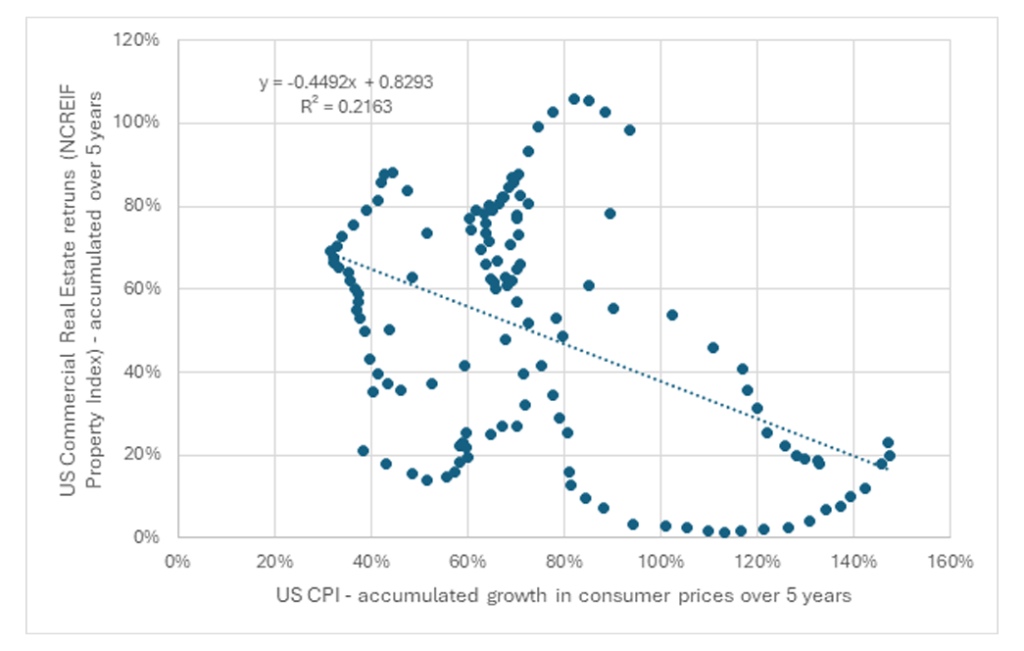
It is also very interesting to note that commercial real estate, as represented by the NCREIF Property Index, has a negative correlation of -0,47 to inflation over the same period, se figure 2.
Figure 2: Correlation of commercial real estate with inflation
Source: Bloomberg & own calculations
Analyzed period: Q1-1987 until Q1-2025
While commercial real estate is often assumed to protect against inflation, the reality is more nuanced.
Timberland benefits from direct commodity exposure, biological growth, and low operating leverage, while commercial real estate, despite being tangible, suffers from structural frictions that delay or dilute its inflation pass-through. Timber prices tend to respond more directly to inflationary pressures, particularly through their link to construction and industrial demand, and timberland owners can strategically time harvests to capitalize on favorable price environments. In contrast, commercial real estate income is typically governed by long-term lease agreements, which adjust slowly to changes in consumer prices. Additionally, CRE is more exposed to rising operating and financing costs, such as energy, maintenance, and interest rates, which can erode real returns during inflationary periods. As a result, while both asset classes fall under the “real assets” umbrella, timberland has historically shown a stronger and more consistent correlation with inflation than commercial real estate.
Portfolio Characteristics: Diversification and Stability
From a strategic asset allocation perspective, timberland serves several roles in a portfolio:
- Diversification: Timberland has shown a low correlation with equities, fixed income, and even other real assets like real estate. This makes it a powerful diversifier.
- Inflation Protection: Timber prices, and therefore forest valuations, tend to move with inflation over time. Timberland investments therefore can protect the purchasing power.
- Capital Preservation: Forestland is a real, tangible asset. It doesn’t depreciate in the same way buildings do, and it holds intrinsic value that can help protect wealth.
- Sustainability: Timberland investments often meet ESG criteria, particularly when managed sustainably. This makes them attractive to institutional and private investors seeking to align their portfolios with, for example, climate and biodiversity goals.
- Attractive Risk-Adjusted Returns: Timberland[1] has historically produced attractive returns of app. 10% p.a. over the course of the last 38 years, with lower volatility than equities and some other asset classes, which is a strong value proposition on its own.
Historical Returns and Capital Market Assumptions
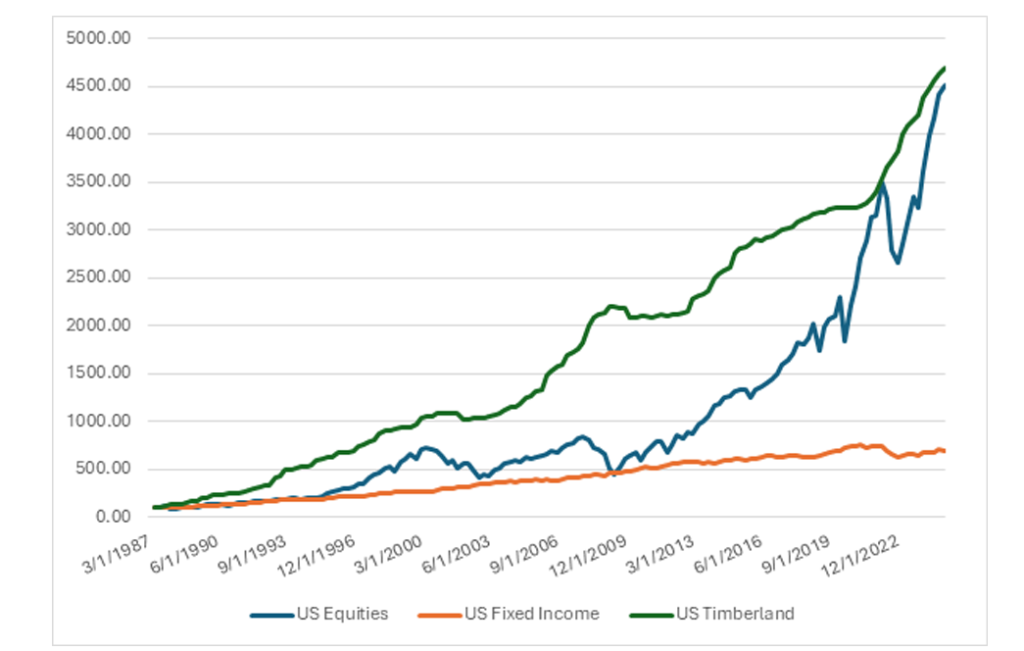
Figure 3 illustrates the cumulative total returns of three major U.S. asset classes from Q1 1987 to early 2025:
- US Timberland (green line)
- US Equities (blue line)
- US Fixed Income (orange line)
[1] NCREIF Timberland Index
Figure 3: Cumulative total returns of timberland, equities and fixed income
Source: Bloomberg & own calculations
Past performance is not indicative of future results
US Timberland has delivered the highest cumulative return over the full period. Its growth path is remarkably stable with fewer drawdowns, highlighting timberland’s low volatility and resilience, especially during equity downturns, but also reflecting illiquidity and appraisal-based pricing, which tend to dampen short-term price swings.
The historical correlation between timberland and equities and fixed income was very close to zero, meaning that timberland has historically been a great diversifier.
Table 1: Historical correlations
US Timberland |
US Equities |
US Fixed Income |
|
US Timberland |
1 |
0,03 |
0,14 |
US Equities |
1 |
-0,02 |
|
US Fixed Income |
1 |
Source: Bloomberg & own calculations
Even though the historical return of US Timberland has been app. 10% p.a., past performance is not indicative of future results. I would therefore recommend looking at the capital markets assumptions of leading asset managers for a forward-looking assessment of the attractiveness of the asset class. The return estimates range currently from low single digits for Nordics to double digits in nominal terms for some Emerging Markets. Important to note in that connection is that the expected risk for timberland in these capital market assumptions is substantially lower than for equities, resulting in a higher sharpe ratio, meaning a better risk-adjusted return.
ESG Alignment and Carbon Opportunities
Timberland stands out not only as a financial asset but also as a natural ESG investment:
- Carbon sequestration: Forests absorb carbon dioxide, acting as critical carbon sinks. Timberland owners may generate additional income through the sale of carbon credits under regulated or voluntary markets.
- Biodiversity and land stewardship: Sustainable forest management practices can support biodiversity, protect water resources, and prevent soil erosion. Timberland owners may generate additional income through the sale of mitigation banking credits.
- Social value: Forestry operations often support rural employment and sustainable economic development.
- Decarbonization of other sectors: Wood-based products like CLT (cross-laminated timber) can replace concrete and steel in the building sector and thereby contribute to the decarbonization of the building sector. But wood-based products can also replace plastic-based products and thereby contribute to a greener future.
As investors face increasing pressure to align portfolios with net-zero targets and sustainability mandates, timberland emerges as a rare asset that provides both positive environmental impact and competitive financial returns. And while many people have objections to wind farms in their backyard, I have yet to meet anybody complaining about forests.
The Market for Timberland Investments
The largest market for institutional timberland investments is the USA, followed by Oceania (Australia & New Zealand) and Latin America. Outside North America and the Southern Hemisphere, forest-rich countries like Sweden and Finland hold vast timber resources, but institutional investment patterns differ. In Scandinavia, large proportion of forestry is still domestically held (often family or corporate-owned), though Swedish pension funds (AP funds) and endowments invest globally including in forests. Another European market for timberland investments are the Baltic countries, which are a fragmented market offering good opportunities for aggregation strategies and with lower land prices than in the Scandinavian markets. One of the major forest owners in the Baltics is Ingka Group, the company behind the IKEA stores. The role of the Baltics for timber supply has only increased since Russia’s invasions of Ukraine and the following embargoes against Russia and Belarus, who used to be major timber suppliers.
Risks to Consider
No investment is without risk, and timberland is no exception. Key risks include:
- Illiquidity: Secondary markets are limited, and capital is typically locked in for long periods.
- Natural risks: Fires, pests, storms, disease and climate change can reduce timber volume or quality.
- Regulatory risks: Forestry is subject to environmental regulations and land-use restrictions that may evolve over time.
- Market volatility: Timber prices are cyclical and can be affected by housing markets, global trade flows, and substitute materials.
- Geopolitical risks: The recent invasion of Ukraine by Russia highlights the geopolitical risks of land investments. Due to the proximity to Russia, the Baltic States and Finland are more vulnerable than for example investments in Northern America or Latin America. A mitigating factor is that these states are Nato members.
However, for long-term investors with a clear strategy and capable partners, these risks are generally manageable and well-compensated. The best mitigation against these risks is diversification – both geographically and across species, as some species are less vulnerable to pests and climate change than others.
Illiquidity: The Price of Patience
Timberland is not a liquid asset. Most investments require a holding period of at least 10 years, often longer. But that illiquidity is not necessarily a disadvantage. In fact, it can be a strength for those who don’t need immediate access to capital and are focused on long-term wealth creation.
For investors, illiquidity risk can be mitigated through thoughtful portfolio construction, such as blending timberland with more liquid real assets or managing the timing of capital commitments and distributions across multiple vintages or regions. Additionally, the emergence of secondary markets, while still limited, provides some optionality for liquidity under specific circumstances.
In a world increasingly dominated by short-termism, timberland requires – and rewards – patience. It’s an asset class well suited for investors who understand that some of the best investments take time to grow – quite literally.
The Role in Strategic Asset Allocation
For strategic allocators, timberland is increasingly seen not as a niche play, but as a core component of the real asset sleeve. A growing number of pension funds, endowments, and sovereign wealth funds allocate to timberland or forestry-related assets.
Timberland can complement other real assets like infrastructure and real estate while reducing overall portfolio risk. It may also serve as a partial substitute for fixed income in a low-yield environment, especially for investors seeking real returns over nominal guarantees.
Depending on investor profile and objectives, timberland may serve multiple roles:
- A substitute for low-yielding bonds
- A real asset for inflation protection
- An ESG-aligned anchor within a sustainable portfolio
- A long-duration asset for intergenerational wealth transfer
Conclusion: Quiet Strength in a Noisy World
As the world transitions toward a more sustainable economy, investors are rethinking the foundations of their portfolios. Real assets, particularly those aligned with environmental goals, are rising in importance. Timberland may not be the flashiest investment, but it fits this paradigm perfectly:
- Real returns rooted in biological growth
- Diversification that strengthens portfolios in times of stress
- Inflation protection backed by land and timber value
- ESG alignment with measurable climate impact
It is, quite literally, an investment where money grows on trees.
It is important to note not all real assets hedge inflation equally. Timberland benefits from direct commodity exposure, biological growth, and low operating leverage, while commercial real estate, despite being tangible, suffers from structural frictions that delay or dilute its inflation pass-through.
For investors willing to take the long view, timberland deserves serious consideration. Not as a peripheral play, but as a strategic allocation that combines financial logic with environmental responsibility. In a time when sustainable growth is more than a metaphor, investing in forests may be the most grounded decision of all. And while some continue to favor commercial real estate, perhaps out of habit or incomplete analysis, the evidence increasingly points to timberland as the more robust, inflation-resilient choice.
Disclaimer:This article is intended solely for educational and informational purposes. It does not constitute investment advice, financial advice, or any other form of professional guidance. The views and opinions expressed are those of the author and do not necessarily reflect those of any affiliated organizations. Readers should conduct their own research and consult with a qualified financial advisor before making any investment decisions.
Please note that historical returns, performance data, or market trends discussed in this article are not indicative of future results. Investing involves risk, including the potential loss of principal.

About the author
Christoph Junge is the founder of Alternative Investments Research & Education, providing courses and consulting services in Alternative Investments. Previously, he served as Head of Alternative Investments at Velliv, a major Danish pension fund, and has extensive experience in Asset Allocation, Manager Selection, and Investment Advisory from roles at Nordea, Tryg, and Jyske Bank. He holds the Chartered Alternative Investment Analyst (CAIA) designation and brings more than two decades of experience from the financial sectors of Denmark and Germany. He is a sought-after speaker and advisor, known for combining deep industry expertise with a practical, forward-looking approach to investing.